Lifelong Learning and Teaching in Medicine

Paul SufkaEducation

2013 01 19 14 13 30

 “It gave a tremendous level of self-confidence, that through exploration and learning one could understand seemingly very complex things in one’s environment.” – Steve Jobs

In medicine, we knowingly commit ourselves to lifelong learning. Very early in our medical education, most of us are told that some portion of what we are taught will be found to be incorrect (or at least will be updated), which requires each of to find ways to keep up with our respective fields. Despite the amount of learning that we do, many of us have little understanding of the actual learning process.

A commonly used phrase in medicine is “see one, do one, teach one”, making reference to increasing levels of understanding of the subject matter.

A more formal model to classify levels of learning objectives is Bloom’s Taxonomy (Wikipedia), which is divided into three types of learning, or domains: cognitive (knowledge), affective (emotional), and psychomotor (physical skills). For the purposes of medical education and this post, our focus is on the cognitive domain.

The cognitive domain is further divided into six increasing levels of learning, which are recognized by goals and objectives that the learner is able to demonstrate at each level. These have been updated since the original publication (the Wikipedia article above shows the old version).

Below is my attempt to give a simple explanation of the current iteration of the cognitive domain of Bloom’s modified taxonomy (listed from lowest to highest level of learning):

  1. Knowledge: Lowest level actions such as memorizing, recall of information, and basic concepts. Example: Listing types of inflammatory arthritis. 
  2. Comprehension: Understanding of information and meanings as well as context. Example: Understanding that arthritis could be divided into non-inflammatory and inflammatory causes, and further subdividing inflammatory causes into categories such as monoarticular, oligoarticular, and polyarticular.
  3. Application: Problem solving and making use of the information. Example: Recognition of a patient with inflammatory polyarthritis and deciding to order RF and CCP as part of the workup.
  4. Analysis: Organization of parts and recognition of patterns. Example: Recognition that a patient with inflammatory polyarthritis has additional features such as rash and nail pitting, suggesting psoriatic arthritis.
  5. Synthesis: Being able to formulate, defend, and argue information. Example: Developing a treatment plan for a patient that has an unclear diagnosis because of overlapping features.
  6. Creation: Being able to assemble, recommend, criticize, support, or discriminate information. Example: Selecting a treatment plan for a patient who has failed standard therapies or has comorbid conditions making treatment decisions difficult.

The differences between levels of learning can be subtle, but by looking at the action verbs used to describe each level from the references above, you should be able to roughly estimate your current level of understanding for a topic.

As an example, most adult rheumatologists should find themselves at the level of creation in terms of management of rheumatoid arthritis, but might only be at the level of knowledge or comprehension for a topic such as the autoinflammatory syndromes (e.g. Familial Mediterranean fever or TRAPS).

Recognizing your current level of understanding is helpful when you want to increase your level of understanding for a topic. For the autoinflammatory syndromes, one might recognize that they are only aware of the names of these syndromes (knowledge level), and increase their learning level by organizing features that differentiate these syndromes into a chart (comprehension level or higher).

As mentioned above with “see one, do one, teach one”, an effective way to maximize the learning process is to teach. While some of us are actively teaching residents and fellows to keep us functioning at the higher levels of learning, many do not have this option.

My suggestion would be to set up a simple website or blog (which we discuss in episode 6 of the podcast) to share what you have learned with others. The mental processes involved in organizing information to be shared will further advance your understanding, which can be furthered by ongoing discussions on social media. In my case, being part of discussions on The Rheumatology Podcast and posting on the blog there have undoubtedly increased my learning level for a number of topics.

If you’re not ready to make the jump to blogging quite yet, Twitter is an excellent option for sharing short bullet points (for an example of this done extremely well, check out @RheumPearls).

An Update on Gout Management

Paul SufkaEducation, Rheumatology Podcast

Below is a reprint of an article I wrote for Just Joints, an online newsletter for health professionals distributed by the Arthritis Foundation Upper Midwest Region. This article will be posted in the archives eventually, but be sure to check out the other articles in this series. 

Also, be sure to check out Episode 2 of The Rheumatology Podcast, where we discuss an article looking at starting allopurinol during acute gout attacks, as well as some of our other experiences with gout. 


The incidence of gout has risen dramatically in the U.S. population, likely driven by the increased incidence of comorbid risk factors that include obesity, diabetes, chronic kidney disease, cardiovascular disease, and hypertension. Despite advances in current therapies for gout that can prevent unnecessary joint damage, tophi, and recurrent flares, many patients remain undertreated. In October 2012, the American College of Rheumatology (ACR) released guidelines on the  management of gout in two parts. This article will briefly review part one of the recent ACR guidelines, which focus on nonpharmacologic and pharmacologic management of hyperuricemia, which is often misunderstood and mismanaged, but likely plays the biggest role in long term control of gout.

Beginning with focus on patient education on diet and lifestyle changes, most physicians are aware of recommendations on the avoidance of organ meats in the management of hyperuricemia, and are also aware of limiting servings of seafood, beef, lamb, and pork. Avoidance of alcohol, especially beer, is also widely recognized. Newer recommendations that clinicians might not be aware of are to avoid foods and beverages containing high-fructose corn syrup, which has recently been associated with gout.

One of the most important parts of the recent guidelines is the recommendation to lower serum uric acid levels to less than 6 mg/dl at a minimum, and to less than 5 mg/dl in more severely affected patients, such as those with tophi present. Initial treatment of hyperuricemia should begin with one of the xanthine oxidase inhibitors (XOI), typically allopurinol. The initial allopurinol starting dose recommended was 100 mg daily in patients with normal renal function (50mg daily in stage 4 or higher CKD), which needs to be titrated upward until uric acid is at target. Failure to titrate the dose of allopurinol until uric acid levels are at goal is a common mistake in the management of gout.

Some physicians might be undertreating hyperuricemia over concern regarding side effects when increasing the dose of allopurinol, stopping long before reaching the maximal FDA approved dose of 800mg per day. Even in the setting of CKD, with proper monitoring for toxicity, studies have shown that allopurinol doses can safely be increased above 300mg per day, which is also pointed out in the recent recommendations. There are certain patient populations who are considered high risk of severe allopurinol hypersensitivity reactions, especially Koreans with CKD, and those of Han Chinese or Thai descent, and these patients should be screened for the HLA-B*5801 allele prior to starting allopurinol, which is associated with increased risk of hypersensitivity in these groups.

The newer XOI, febuxostat, is typically reserved for patients who have experienced adverse events from allopurinol, or have not achieved uric acid target despite maximal doses of allopurinol. Additional uric acid lowering therapy with uricosuric agents, typically probenecid in the U.S., is advised in patients who do not reach target uric acid levels with an XOI, given they do not have contraindications to these agents such as nephrolithiasis or significant renal impairment. A newer agent given intravenously, pegloticase, which is a recombinant uricase that metabolizes uric acid, can be given to patients with refractory disease.

Part two of the recent gout guidelines give advice on prophylaxis for patients recently started on uric acid lowering therapy to prevent attacks, usually with colchicine, and also discusses management of acute gout flares. Current knowledge of therapeutic strategies for gout has become increasingly important, especially as we are likely to see more patients with this condition in the upcoming years.

The Rheumatology Podcast is Now Available

Paul SufkaRheumatology Podcast

“Real Artists Ship” – Steve Jobs

 “Don’t let the perfect be the enemy of the good” – Voltaire

The Rheumatology Podcast, hosted by Michael Laccheo, Suleman Bhana, and myself  is now available on the website. Update: Now available in iTunes! We also have a Twitter feed @TheRheumPodcast that we’ll be using for updates as well.

This is an initial venture into podcasting for all three of us, and we’re happy with how the first episode turned out. We’re hoping that it will only improve over time as the show evolves and will be as educational for our listeners as it already has been for us.

Please take a listen and let us know any comments, suggestions, or encouragement that you have. We’ll do our best to respond or incorporate any great ideas that we can.

At the time of this posting, plans are well underway for episode 2, with plans to discuss a specific article (to be revealed soon, so that listeners can read it prior to the episode), more discussion on the the use of social media in medicine, and other various topics in technology and rheumatology.

Announcing – The Rheumatology Podcast

Paul SufkaEducation, Med Tech, Rheumatology Podcast

I’m proud to announce, that along with co-hosts Dr. Michael Laccheo and Dr. Suleman Bhana, that the inaugural episode of The Rheumatology Podcast will be released early this next week.

In the first episode, we discuss a bit about who each of us are, electronic medical records, misunderstandings about rheumatology and rheumatologists, social media use in medicine, a few of our takeaways from ACR 2012, and more.

I’ll post links to the first episode when available both here and on Twitter (@psufka).

More details are currently being added to The Rheumatology Podcast website as they become available.

Applying the Pareto Principle (80/20 Rule) to Rheumatology

Paul SufkaEducation

“If you can’t explain it to a six year old, you don’t understand it yourself.” ― Albert Einstein

Update 1/4/2013: This post was republished today in the ACP Internist blog

Since entering the field of rheumatology, I have too frequently heard comments from clinicians admitting their lack of knowledge and understanding in the field of rheumatology.

I understand why rheumatology has gotten a reputation as being difficult. The basis for the understanding of rheumatic conditions is the immune system, where our knowledge is becoming ever complex. Many of the rheumatic conditions are uncommon, so clinicians are less comfortable recognizing and treating them. To make things worse, we order a number of oddly named antibodies and use medications that affect the immune system in strange ways.

Fortunately, the basics of rheumatology are not extremely difficult to understand.

The Pareto Principle (80/20 rule)

The Pareto Principle says that 80% of the results come from 20% of the effort, knowledge, or resources. This rule has been shown effective  in numerous fields outside of medicine, especially business and finance, and can be used as an effective technique to approach any difficult topic.

With this in mind, I’ll try to focus on the 20% of rheumatology that I think is the most high yield for those outside of rheumatology to understand.

(Sorry fellow rheumatologists, this post isn’t intended to teach you much of anything, but might be helpful when you give guidance or mentor others. I would GREATLY appreciate any additions or corrections in the comments section below).

The unifying mechanism in the rheumatologic diseases is inflammation

Recognition of inflammation is really the first step in thinking about the rheumatologic diseases. With few exceptions, the first thing I’m trying to decide with every new patient I see in the office is whether an inflammatory condition is present, or not.

Recognition of inflammation goes back to the very basics of what we are taught in medicine: the history and physical exam

Joint pain is an extremely common complaint. Being able to differentiate inflammatory from non-inflammatory joint pain is likely the most high yield knowledge in rheumatology. Differentiating these two processes is important because the treatment strategy will vary greatly between the two types.

Taking a pain history: OPQRST

Many of us are taught early in our training the mnemonic “OPQRST” to remember the components of a taking a history. While likely very basic, this is worth reviewing, as details discovered here can greatly change suspicion for inflammation later on.

  • Onset – When did the symptoms start? Rapid or slow onset?
  • Provoking/palliating factors – How are the symptoms affected by use? What about rest? Do anti-inflammatories or other medications help? What else have they tried?
  • Quality (description) of the pain – Dull, aching, stiffness, burning, etc?
  • Regions/radiation – What joints or other areas are involved? (Remember to ask about the neck and back) Does the pain radiate from one area to another?
  • Severity – Generally rated on a scale of 0-10
  • Timing – Constant or intermittent symptoms? Does it change throughout the day (morning stiffness)?

In terms of differentiating inflammatory from non-inflammatory causes, the most helpful are the provoking/palliating factors, and the timing of the symptoms. Inflammatory arthritis is typically associated with pain that is worst in the morning or after resting, with stiffness typically lasting 30-60 minutes or more, and improves with activity.

The complete review of systems: finding the puzzle pieces

The next most powerful tool that rheumatologists use is the complete review of systems. Lack of comfort with what questions to ask,  or the feeling that this takes too much time, is likely another reason that many clinicians are uncomfortable with rheumatology. In reality, the puzzle pieces found in the complete review of systems is often where the bigger picture starts to come into place. Feeling overwhelmed? Use the patient as a guide, starting head to toe, to help remember features to ask. Use a checklist if needed at first, or consider using this rheumatologic patient history form from the ACR.

The cardinal signs of inflammation on exam: if you don’t know what to look for, you won’t find it

Most of us are aware of the five cardinal signs of inflammation, but might not have been taught some of the details to look for:

  1. Dolor (tenderness on palpation)
  2. Calor (heat): The joint is typically cooler than the surrounding tissues.
  3. Rubor (redness/erythema)
  4. Functio laesa (loss of function): Typically decreased ROM due to tenderness. If joint function is normal, consider surrounding tissues as the cause of pain. This can be particularly helpful in differentiating cellulitis and/or bursitis from joint inflammation and septic joints.
  5. Tumor (swelling):
  • Look for loss of “dimples” around the joint & decreased skin lines over the joint
  • Feel for the edges of the joint to feel “boggy/squishy” or less distinct
  • Feel small joint swelling/effusions by pushing with one finger & sensing with the other

The Rheumatology Image Bank, especially comparing images of rheumatoid arthritis and osteoarthritis is great resource to look further at these details.

A more detailed resource for rheumatologic exam tips can be found here: http://physicalexamination.org/?q=node/56

Palpating joint inflammation: practice, practice, practice!

With enough practice, you can learn to palpate synovitis (I have taught medical residents to do this in clinic over the course of a morning). Practice palpating your own joints (assuming they are normal), especially the hands. You typically should easily be able to feel the edges of the joint lines, with only the sense of a normal, thin layer of skin separating the joints from your fingers. If you feel boggy/squishy or less distinct joint lines, along with other features from above, inflammation is more likely.

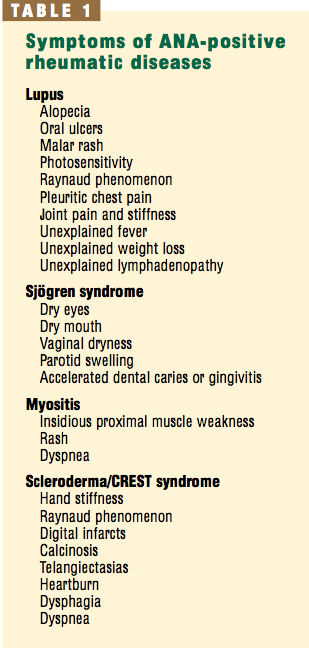
When to order an ANA

This article: Cleveland Clinic Journal of Medicine 2002; 69(2):143-146 (full text and pdf available without subscription) is a great review of when to order an ANA for our patients.

In summary an ANA should be ordered when the pretest odds of autoimmune disease are high, which is based on findings from our history and physical, summarized  in the table below:

Rheumatoid factor (RF): consider causes other than rheumatoid arthritis

Similar to the ANA, the RF should be ordered when the pretest odds of rheumatoid arthritis are high, which requires joint inflammation/synovitis to be present, and increases with the number of affected joints (refer to this excerpt from the 2010 ACR/EULAR RA Classification Criteria for Rheumatoid Arthritis; see also: link to complete pdf article). When suspicion of rheumatoid arthritis is high, typically an anti-CCP is also ordered.

Keep in mind that a positive RF is common in a number of other rheumatic disorders (Sjogren’s syndrome and cryoglobulinemia being most common, but the other connective tissue diseases such as lupus to lesser degrees).

The most common other condition that causes a positive RF is hepatitis C infection, which must be ruled out when a positive RF is detected (additionally, hepatitis C infection is associated with an inflammatory arthritis).

Other conditions associated with positive RF include hepatitis B, lymphoproliferative disorders, malignancy, chronic infections, inflammatory lung conditions.

Common mistakes in gout management

When I asked for suggestions for high yield rheumatology topics on Twitter, gout quickly came up multiple times. Since the incidence of gout is on the rise, likely related to increased risk factors (obesity, diabetes, chronic kidney disease, cardiovascular disease, and hypertension), knowledge of appropriate management will only become more important.

Gout management is divided into acute management (typically treated with prednisone; colchicine, or NSAIDs) and management of hyperuricemia.

The management of hyperuricemia is where most errors in management occur, especially failure to lower the uric acid to 6.0 or less. In most patients, this is accomplished by titrating the allopurinol dose every few weeks until this is achieved, and many clinicians fail by never titrating to a high enough dose to reach this goal. Additionally, most patients are placed on prophylaxis against attacks when first initiating medications to lower uric acid, since risk of flare is highest during this time. These topics are covered nicely in a two part update, published in October 2012.

In closing, I hope this serves as a good starting point for clinicians to become more comfortable in the field of rheumatology. I invite my rheumatology colleagues to post additions, corrections, and any comments below.