Decision Fatigue in Physicians and Medicine: The Importance of Routines and Habits

Paul SufkaMedical Practice

SF-tree2

“Everything must be made as simple as possible. But not simpler.” — Albert Einstein

One of the most mentally fatiguing actions that physicians face on a daily basis is the number of decisions we must make. Although we likely only make one or two major decisions for every patient encounter, in total we make hundreds (or maybe thousands) of decisions every day. This includes deciding what labs, imaging, and other studies to order, followed by what those results mean, a diagnosis or list of possible diagnoses, treatments, monitoring, patient follow up, etc.

Unfortunately, it has been shown that the more decisions that we make over the course of a day, the worse we become at it.

The New York Times article Do You Suffer From Decision Fatigue? (highly suggested; approximately 22 minute read) begins by describing the rulings of parole board judges over the course of a year, finding that the pattern of their decisions fluctuated throughout the work day, favoring the prisoners who appeared early in the day.

The more choices you make throughout the day, the harder each one becomes for your brain, and eventually it looks for shortcuts, usually in either of two very different ways. One shortcut is to become reckless: to act impulsively instead of expending the energy to first think through the consequences.

The other shortcut is the ultimate energy saver: do nothing. Instead of agonizing over decisions, avoid any choice.

Decision fatigue was described by Dr. Roy F. Baumeister, who demonstrated that humans have a finite store of mental energy for making decisions, which can be broken down into the Rubicon model of action phases:

  1. Predecisional Phase – assessing wishes and forming intended goal
  2. Preactional Phase / Making a Decision – planning and choosing goal-directed actions
  3. Actional Phase – implementing chosen actions
  4. Postactional Phase – evaluating whether goal was achieved

It turns out that a number of studies have shown that the act of making the decision and committing to action is more mentally demanding than any other phase.

The idea of decision fatigue is explained by Dr. Baumeister through a theory called ego depletion, where decisions are higher level executive functions thought to occur in the prefrontal cortex, and every decision we make, no matter how important or unimportant, expends some of the energy of this system, until our ability to make decisions deteriorates.

Once you’re mentally depleted, you become reluctant to make trade-offs, which involve a particularly advanced and taxing form of decision making. In the rest of the animal kingdom, there aren’t a lot of protracted negotiations between predators and prey. To compromise is a complex human ability and therefore one of the first to decline when willpower is depleted.

This reluctancy to make trade-offs explains why the parole judges were reluctant to decide to give prisoners parole at the end of the day. As physicians, we need to be aware of the tendency for decision fatigue to occur during our long days. Unfortunately, there is no telltale symptom of when willpower to make decisions is low, and the best method to avoid decision fatigue is planning routines to avoid it:

“Good decision making is not a trait of the person, in the sense that it’s always there,” Baumeister says. “It’s a state that fluctuates.” His studies show that people with the best self-control are the ones who structure their lives so as to conserve willpower. They don’t schedule endless back-to-back meetings. They avoid temptations like all-you-can-eat buffets, and they establish habits that eliminate the mental effort of making choices. Instead of deciding every morning whether or not to force themselves to exercise, they set up regular appointments to work out with a friend. Instead of counting on willpower to remain robust all day, they conserve it so that it’s available for emergencies and important decisions.

Any opportunity to learn from extreme cases can offer incredible insight, and an extraordinary example of a decision maker to study is President Obama in Michael Lewis’ article, Obama’s Way, where he discusses routines with the President, who is well aware of the effects of decision fatigue:

You also need to remove from your life the day-to-day problems that absorb most people for meaningful parts of their day. “You’ll see I wear only gray or blue suits,” he said. “I’m trying to pare down decisions. I don’t want to make decisions about what I’m eating or wearing. Because I have too many other decisions to make.” He mentioned research that shows the simple act of making decisions degrades one’s ability to make further decisions. It’s why shopping is so exhausting. “You need to focus your decision-making energy. You need to routinize yourself. You can’t be going through the day distracted by trivia.” [Emphasis added]

An article from EMSWorld, When Thinking is Hard: Managing Decision Fatigue, discussed the implications of decision fatigue for EMTs and paramedics and agreed that trying to reduce overall decision load was the best way to manage this problem, and noted that individuals who were able to do this had routines and habits that included thoughtful planning, which reserved willpower for when it was needed most. As healthcare professionals, they noted the importance of having these planned routines:

We tell ourselves it’s how we perform under pressure that counts most, but the sum of who we are as professionals is just as much determined by the everyday habits which make up our work.

The idea that having specific routines to improve productivity is not new. The American philosopher and physician William James (1842-1910) wrote in detail about the importance of forming regular routines and the subsequent effect of allowing our brains to remain productive in his book Habit (open domain; review on Brain Pickings).

The book, Daily Rituals: A Guided Tour of Writers’ and Artists’ Creative Habits, which describes the routines of 161 famous and inspired minds (also reviewed on Brain Pickings), is another opportunity to learn from extreme thinkers, and also quotes one of William James’ 1892 lectures from the book Habit:

The great thing, then, in all education, is to make our nervous system our ally instead of our enemy. It is to fund and capitalize our acquisitions, and live at ease upon the interest of the fund. For this we must make automatic and habitual, as early as possible, as many useful actions as we can, and guard against the growing into ways that are likely to be disadvantageous to us, as we should guard against the plague. The more of the details of our daily life we can hand over to the effortless custody of automatism, the more our higher powers of mind will be set free for their own proper work. [Emphasis added]

At this point, the effect of decision fatigue in medicine needs further research for both physicians and patients. The University of Pennsylvania currently has two studies ongoing on this topic, one looking at its role in the ICU and another looking at its role in patients’ and patient surrogates’ end-of-life choices. The Journal of Palliative Medicine has written about the problem of decision fatigue for patients who are already exhausted from severe illness, acting as a reminder to give patients and their families a chance to regroup before making important decisions.

As MDs, we will always be required to make numerous daily decisions, so we need to do what we can try reduce our own decision fatigue, which might actually improve our work as a physicians and lives in general:

  • Spend some time thinking about your routines at home and at work to avoid making additional decisions. Many of the routines described in Daily Rituals included repeating meals, dressing/grooming habits, and setups for getting work done.
  • Make important or difficult decisions first in the morning. Many of us have a habit of checking email first thing in the morning, which is often filled with a number of unimportant decisions that can wear us down. Instead, save this time of day for the tough ones.
  • When possible, put off difficult decisions that come up at the end of the day until the next morning. In the field of rheumatology, we are often faced with complex decisions, but luckily, the majority of them are not extremely time sensitive, allowing us time to research and discuss with collagues.
  • I find it difficult to say anything to the effect of “workup every case of x with tests a, b, and c”, but I do think that as physicians, we do need to have a good understanding of the workup and management for the common conditions in our fields, such that we are able to reserve decision making energy throughout the day.

Any suggestions on routines or other habits that you have found helpful? Mention them in the comments.

###

Update 11/19/2014 – Links to related articles:

Social Media and the Tweetups at #ACR13

Paul SufkaConferences, Education, Rheumatology Podcast, Social Media

2013 10 25 14 45 06

I was fortunate again this year to attend my sixth American College of Rheumatology Annual Meeting (ACR) in San Diego.

This year was much different than every other because of the (self-imposed) stress of organizing the #ACR13 tweetups, relating to my goal of trying to spend time meeting with people at medical conferences. I want to thank everyone who attended. Every year the tweetups have lead me to numerous ventures following the meeting, and the most notable of these have been the chance to help Crescendo Bioscience on their iOS app MyRA, as well as our ongoing project, The Rheumatology Podcast.

Every year, the use of Twitter at ACR has gotten bigger and better. It was great to meet Dr. Christopher Collins of @RheumPearls, who presented a session on The Use of Social Media in Rheumatology Education and Practice, which was a fantastic overview of the various networks that rheumatologists are using to connect.

Following #ACR13, Dr. Ronan Kavanagh wrote a great post discussing his experience with how Twitter allows one to enhance learning at medical conferences:

Live-tweeting as part of a community also allows participants to feel that they are taking part in the meeting – rather than just being passive recipients of information. It is during the informal information exchange between people that the real learning resonances and cementing of useful information takes place.

I completely agree that social media is probably the most accessible way to enhance learning at medical meetings, as users move from being a passive attendee of a lecture to an active participant. Being active in the conversation amplies the benefits of the meeting by bringing you to a higher cognitive level of learning.

The #ACR13 Tweetups went extremely well, and I’m very happy that so many people were able to make it. Since the goal of the Tweetups were to get people to connect, my request is for anyone that attended to make a point to follow up with someone you met in person. As I mentioned, each time this has led me to interesting things, and my hope is it will do the same for others.

###

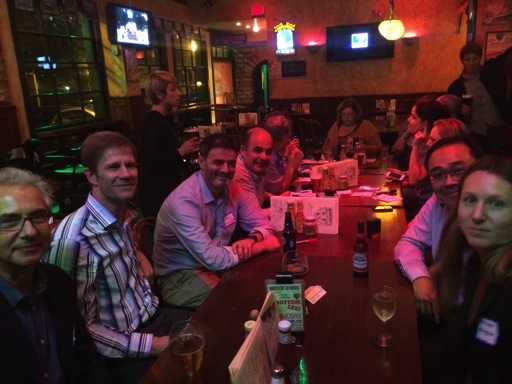
The first gathering was Sunday evening at an Irish-style pub called Hennessey’s Tavern, with about 20 attendees.

2013 10 27 17 26 55

2013 10 27 18 29 43

2013 10 27 19 05 12

###

Pictured below is myself with Dr. Antoni Chan, who following ACR has started a new blog called Joint Venture. His most recent post does a great job reviewing the mechanisms of HLA-B27 in ankylosing spondylitis.

2013 10 28 00 38 50

###

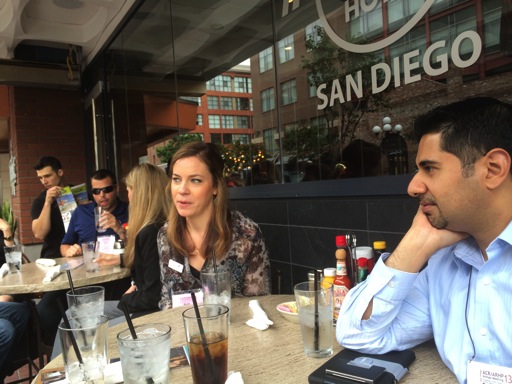
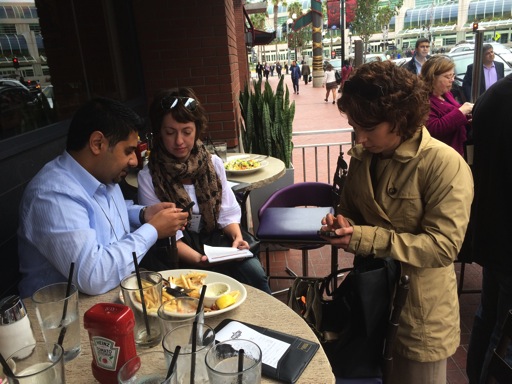
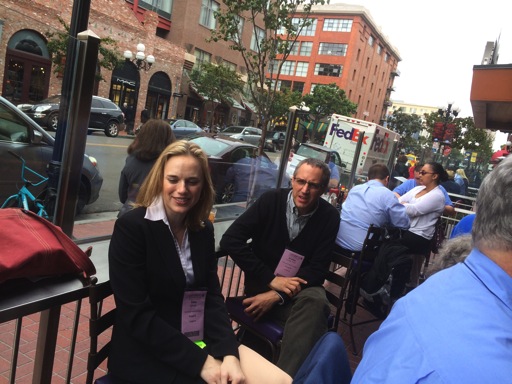
The second gathering was over lunchtime on Monday at Maryjane’s cafe at the Hard Rock Hotel, also with about 20 or so attendees, most who had not been at the first tweetup.

2013 10 28 11 37 46

2013 10 28 12 30 11

2013 10 28 13 34 13

2013 10 28 12 30 21

Dr. Lothar Kirsch has also posted about the social aspect of #ACR13, including pictures of the tweetups

Update 12/4/2013: Dr. Philip Robinson’s post: My #ACR13 news, highlights and suggestions

Also, check out our wrap-up of #ACR13 on The Rheumatology Podcast.

Thanks again!

#ACR13 TweetUp – San Diego

Paul SufkaConferences, Social Media

ACR tweetup400x400

Here’s the current plan for our social medial Tweetup for #ACR13 in San Diego:

*** updated 10/3/2013 with plan for lunchtime session at Maryjane’s ***

*** updated 10/26/2013: Twitter highlights from #ACR13 review course ***

This year, we’ll be having two events, in hopes that more people can attend.

This is an open event. Anyone interested can attend. You do not have to RSVP, but if you are planning or thinking of attending, please let me know so that I can try to give the venues an updated idea of how much space we might need.

Sunday October 27th – 6:00pm

  • Hennessey’s Tavern – 708 4th Avenue, San Diego, CA 92101 (Google map)
  • Approximately 11 minute walk from convention center.
  • There will be no specific end time to this event. If you’re running late and wondering if anyone is still there, feel free to message me at @psufka on Twitter. I’ll do my best to respond ASAP.

Monday October 28th – Lunchtime session – approximately 12:00-2:00pm

  •  Maryjane’s at Hard Rock Hotel San Diego -207 5th Ave, San Diego, CA (Google map)
  •  Across the street from the convention center

Blog posts from prior Rheumatology Tweetups:

 Some suggestions for planning and attending ACR (or other large medical meetings):

Can’t wait to see everyone there!

###

Let me know if anyone has comments or suggestions? I’ll keep this post updated.

Also let me know if I’m missing links to other blog posts from other past Rheumatology Tweetups.

Welcome ‘The Rheumatologist’ Readers

Paul SufkaSocial Media

MBP

“How can you squander even one more day not taking advantage of the greatest shifts of our generation? How dare you settle for less when the world has made it so easy for you to be remarkable?” – Seth Godin

Welcome to anyone who is here after reading the article “A Rheumatologist’s Tips for Tweeting and Blogging” in the June 2013 issue of The Rheumatologist. Thanks for checking out my blog!

A few of my favorite posts to introduce you to my blog:

My main other project online is The Rheumatology Podcast, where I am one of three other co-hosts of a biweekly audio discussion regarding rheumatology and technology topics. Episodes are also available on iTunes. I would greatly appreciate it if you would check it out!

Twitter has been a great way for me to connect with many other rheumatologists and other physicians all over the world, many of whom I have been able to meet at national ACR meetings. I wrote a three part series of blog posts regarding rheumatologists from around the world that I have interacted with online.

Twitter is also greatly useful in ongoing medical education. At the time of writing this post, I have been actively following a number of rheumatologist tweeting updates from EULAR 2013 in Madrid (June 12-15, 2013).

If for no other reason, physicians should become involved in social media because there are two realities regarding your online reputation, as Dr. Bryan Vartabedian points out,:

1. You have no control over what people say

2. You have 100% control of the story you createHow to control reputation online

I strongly advocate for starting your own website or blog, even if used for nothing more than having your name on the internet with your clinic contact information. A simple way to create your own website was posted on our podcast website and was discussed on episode 6 of our podcast.

I would be happy to connect with anyone. Feel free to write a comment below, drop me a note through my contact page, or else contact me at @psufka on Twitter.

Flat Design and EMRs

Paul SufkaMed Tech

Nest

“Indifference towards people and the reality in which they live is actually the one and only cardinal sin in design.” – Dieter Rams

A current trend in software user interface is called flat design, which tries to:

  • Embrace the fact that we are working in a two-dimensional (“flat”) digital workspace (as opposed to a physical item, such as a paper chart)
  • Clean up visual appearance by embracing the whitespace and removing unnecessary borders and edging.
  • Focus keeping the interface minimalistic and efficient.

An example of efficient design that comes to mind is described in Steve Jobs’ biography, where he had recognized (and demanded) the need to limit any user action to as few steps as possible while designing the original iPod with the click wheel.

Flat design is the next evolution of Dieter Rams ten principles of good design.

Compare this to skeuomorphism, defined in this interactive infographic, as “a design element of a product that imitates design elements that were functionally necessary in the original product design, but which have become ornamental in the new design.”

Skeuomorphic design is highly prevalent in EMR systems, which try to mimic paper medical records. The problem with this is assumption that most physicians are used to using paper charts, and that imitating these old design elements electronically is going to improve user experience. As in the Dieter Rams quote above, indifference to the reality that EMRs need to be updated to the modern electronic world is a cardinal sin in their design.

In fact, efforts to make EMRs mimic paper charts may be making usability and understanding worse, increasing training time to as much as 12 hours. Many have an array of redundant, outdated, or unclearly labeled tabs that were previously useful in a paper chart. Most of them still lack any type of advanced search, which is a critical function when trying to make any use of big data. The format by which many lab results and other patient data is often thoughtlessly displayed as just electronic copy of what would previously be printed out, as opposed to a format that is designed to improve understanding and actionability. The simple act of ordering a patient prescription is made much more difficult by trying to copy features of the paper prescription pad, as opposed to giving the clinician ways to make this process more efficient and less error prone. Some examples of poor user interface design in EMRs are beyond explanation.

While I don’t necessarily expect an EMR to be easy to use, we do need efforts made to simplify workflow in the world of modern patient care.

Update (5/28/13): Also check out Designmodo’s Principles of Flat Design

Update (7/2/13): Article from The Economist: What is skeuomorphism?